The Uralic language family
Finnish and its relatives
Follow Finnish’s language family across northern Eurasia. Maps, speaker figures, word comparisons, and grammar examples reveal both shared history and the distinctive life of every language.
A language atlas
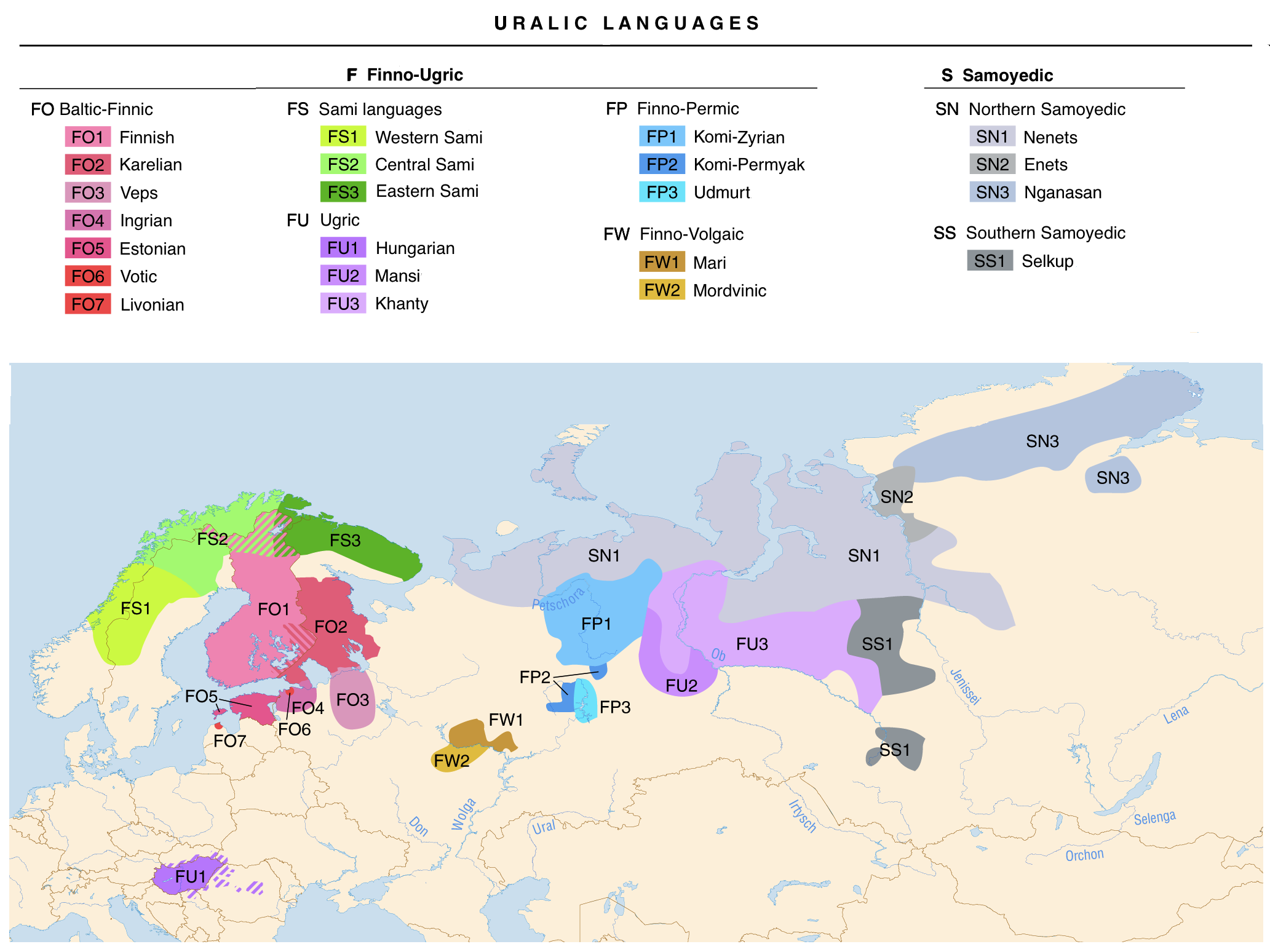
Uralic languages on the map
The family stretches from Central Europe and the Baltic region through Sápmi, the Volga–Kama region, and western Siberia to the Taymyr Peninsula.
Living languages
How many people speak them today?
Finnic languagesFinnish and Estonian are national languages; several of their closest relatives have only small or revitalizing communities.open
| Language | Speakers | Core area | Basis of figure |
|---|---|---|---|
| Finnish | 4,719,802 | Finland; also Sweden and diaspora communities | Registered mother tongue in Finland, 2025 |
| Estonian | 890,104 | Estonia; also Finland and diaspora communities | Registered mother tongue in Estonia, 2026 |
| South Estonian (including Võro and Seto) | about 50,000 | southern Estonia and nearby areas | research estimate, 2012 reference table |
| Meänkieli | about 30,000 | Torne Valley, Sweden | research estimate, 2012 reference table |
| Karelian | about 30,000 | Russia and Finland | research estimate, 2012 reference table |
| Livvi / Olonets Karelian | about 15,000 | Russian Karelia | research estimate, 2012 reference table |
| Kven | about 5,000 | northern Norway | research estimate, 2012 reference table |
| Veps | about 3,500 | northwestern Russia | research estimate, 2012 reference table |
| Ludic | about 300 | Russian Karelia | research estimate, 2012 reference table |
| Izhorian (also called Ingrian) | at most about 70 strong first-language speakers | historical Ingria, Russia | Finnish Literature Society learning resource |
| Livonian | small revitalization community; no agreed current total | Latvia and diaspora communities | older continuous native-speaking generation ended in 2013; new speakers and learners remain |
| Votic | at most about 5 strong first-language speakers | historical Ingria, Russia | Finnish Literature Society learning resource |
Sámi languagesNine Sámi languages are spoken today. Speaker numbers are estimates because countries record language in different ways.open
| Language | Speakers | Core area | Basis of figure |
|---|---|---|---|
| Northern Sámi | about 15,000–25,000 | Norway, Sweden and Finland | recent scholarly range |
| Lule Sámi | about 1,000–2,000 | Sweden and Norway | recent scholarly range |
| Southern Sámi | about 600 | Norway and Sweden | recent research estimate |
| Inari Sámi | about 300–400 | Finland | Institute for the Languages of Finland; speaker numbers are growing through revitalization |
| Skolt Sámi | about 300–400 | Finland; historical communities also in Norway and Russia | Institute for the Languages of Finland |
| Kildin Sámi | about 300–600 | Kola Peninsula, Russia | recent published range |
| Pite Sámi | about 40 | Sweden and Norway | recent research estimate |
| Ume Sámi | fewer than 20 | Sweden and Norway | recent research estimate |
| Ter Sámi | only a handful; estimates differ | Kola Peninsula, Russia | critically endangered; exact count uncertain |
Volga and Permic languagesThese figures remain useful reference estimates, but most are not current counts and language shift has continued.open
| Language | Speakers | Core area | Basis of figure |
|---|---|---|---|
| Erzya | about 300,000 | Russia | 2012 reference estimate |
| Moksha | about 150,000 | Russia | 2012 reference estimate |
| Meadow / Eastern Mari | about 360,000 | Russia | 2012 reference estimate |
| Hill Mari | about 20,000 | Russia | 2012 reference estimate |
| Udmurt | about 350,000 | Russia | 2012 reference estimate |
| Komi-Zyrian | about 160,000 | Russia | 2012 reference estimate |
| Komi-Permyak | about 60,000 | Russia | 2012 reference estimate |
Hungarian, Ob-Ugric and Samoyedic languagesHungarian is spoken by millions in Central Europe; its distant Uralic relatives extend east across western Siberia to the Taymyr Peninsula.open
| Language | Speakers | Core area | Basis of figure |
|---|---|---|---|
| Hungarian | about 13 million worldwide | Hungary and neighboring countries; diaspora worldwide | broad contemporary estimate |
| Northern and Eastern Mansi | about 1,000 combined | western Siberia, Russia | 2012 reference estimate |
| Northern and Eastern Khanty | about 8,000 combined | western Siberia, Russia | 2012 reference estimate |
| Tundra Nenets | about 25,000 | Arctic Russia | 2012 reference estimate |
| Forest Nenets | about 700 | western Siberia, Russia | 2012 reference estimate |
| Selkup | about 1,000 | western Siberia, Russia | 2012 reference estimate |
| Nganasan | about 150 | Taymyr Peninsula, Russia | 2012 reference estimate |
| Tundra and Forest Enets | about 50 combined | Arctic Russia | 2012 reference estimate |
A small comparison
Shared roots, different sounds
Familiar forms are easy to see in close relatives. In more distant relatives, thousands of years of sound change can hide a shared origin.
| Language | one | two | water | hand | name | I | fish | eye | heart | snow | bread | coffee |
|---|---|---|---|---|---|---|---|---|---|---|---|---|
| Finnish · suomi | yksi | kaksi | vesi | käsi | nimi | minä | kala | silmä | sydän | lumi | leipä | kahvi |
| Estonian · eesti | üks | kaks | vesi | käsi | nimi | mina | kala | silm | süda | lumi | leib | kohv |
| Karelian · karjala | yksi | kaksi | vezi | käzi | nimi | mie | kala | silmy | syväin | lumi | leiby | not listed |
| Northern Sámi · davvisámegiella | okta | guokte | čáhci | giehta | namma | mun | guolli | čalbmi | váibmu | muohta | láibi | gáffe |
| Erzya · эрзянь кель | вейке (vejke) | кавто (kavto) | ведь (veď) | кедь (keď) | лем (lem) | мон (mon) | кал | сельме | седей | лов | кши | not listed |
| Meadow Mari · марий йылме | икте | кок | вӱд | кид | лӱм | мый | кол | шинча | шӱм | лум | кинде | кофе |
| Udmurt · удмурт кыл | одӥг (odi̮g) | кык (kyk) | ву (vu) | ки (ki) | ним (nim) | мон (mon) | чорыг | син | сюлэм | лымы | нянь | кофе |
| Hungarian · magyar | egy | kettő / két | víz | kéz | név | én | hal | szem | szív | hó | kenyér | kávé |
Words of faith
A resemblance does not always mean a shared root
Christian vocabulary has often traveled between languages through churches, translation, and contact with neighboring peoples. Finnish raamattu and risti, for example, are old Slavic loans. Similarities in this table may therefore reveal a history of contact rather than inheritance from a common Uralic ancestor.
| Language | God | Bible | Cross |
|---|---|---|---|
| Finnish · suomi | Jumala | Raamattu | risti |
| Estonian · eesti | Jumal | Piibel | rist |
| Northern Sámi · davvisámegiella | Ipmil | Biibbal | ruossa |
| Hungarian · magyar | Isten | Biblia | kereszt |
Endings build meaning
Many Uralic languages express location, possession, and other relationships with endings. Each language, however, has developed its own system.
Compare how five languages build the meaning “in the house”:
The words are not all cognates, and endings cannot be transferred from one language to another. North Sámi changes the stem, and its locative can express both location and source (†). Meadow Mari гыч is a postposition placed after the noun, not an ending (‡). The examples therefore also show that the languages do not build these meanings in exactly the same way.
No single shared grammar rule
“Uralic” names a historical relationship, not a ready-made grammar template. Over thousands of years, each language and branch has preserved, changed, or lost different features and has also absorbed influences from neighboring languages.
- Vowel harmony
- In Finnish and Hungarian, vowels in a word affect the form of many endings: Finnish talossa but kylässä; Hungarian házban but kertben. Estonian has largely lost its older vowel harmony in the standard language, while Mari has harmony patterns of its own.
- Consonant gradation
- In Finnish and Estonian, stem consonants can alternate during inflection: Finnish matto : maton and Estonian lipp : lipu. Hungarian does not have this Finnic-style consonant gradation.
- Case systems
- Many Uralic languages have numerous case endings, but their inventories, forms, and uses are not identical. Finnish talossa–talosta–taloon, Estonian majas–majast–majja, and Hungarian házban–házból–házba build similar location relationships in different ways.
Similarities among related languages are therefore historical patterns, not rules that can be transferred unchanged from one language to another.
Language is not nationality
A language family describes historical relationships among languages, not a biological family tree of their speakers. Finnish and Hungarian belong to the same distant language family, but their speakers do not form one people, the modern languages are not mutually intelligible, and each has its own history and culture.
The reverse is also true: people who share a country or community may speak languages from different families. Finnish is Uralic and Swedish is Indo-European, yet both are national languages of Finland. Sámi people live across several states and speak several Sámi languages; many people are also multilingual or may be reconnecting with a heritage language.
Language can be an important part of identity, but it is not a reliable test of citizenship, ethnicity, religion, or ancestry. The language a person speaks, or does not speak, cannot define that person on its own.
Sources and a note on classificationOpen the research, statistical, and map sources.open
Language trees, maps, and speaker figures are teaching tools, not immutable facts. Language boundaries, names, and subgroupings can differ among researchers and speaker communities.
- Glottolog: Indo-European
- Glottolog: Uralic
- Oxford Guide to the Uralic Languages: the divergence of Proto-Uralic
- Glottolog: Turkic
- Glottolog: Kartvelian
- M. A. Castrén Society: estimated speaker numbers and their limitations
- Statistics Finland: population by language
- Statistics Estonia: mother tongues at the start of 2026
- Sámi Parliament of Finland: Sámi languages spoken today
- UiT The Arctic University of Norway: comparative Sámi speaker estimates
- GiellaLT: language technology for minority and Indigenous languages
- Comparative Uralic basic-word table
- Institute for the Languages of Finland: Finnish–Estonian false friends
- Institute of the Estonian Language: Sõnaveeb dictionary portal
- Institute of the Estonian Language: differences in Finnish and Estonian morphology
- Institute for the Languages of Finland: Ingrian Finnish, Izhorian, and Votic
- Finnish Literature Society: Izhorians and Votians
- Institute for the Languages of Finland: Sámi languages and current figures in Finland
- University of Latvia Livonian Institute
- University of Vienna: Mari–English Dictionary
- Wikimedia Commons: map source and license