Finnish artists have portrayed biblical narratives and explored faith, suffering, compassion, and hope. This small collection invites visitors to look slowly and notice how familiar Christian subjects acquire distinctive Finnish landscapes and visual languages.
Medieval church art
The Tree of Jesse, or the ancestry of Jesus, 1510–1522
Unknown workshop; photograph by Tomisti
St Lawrence Church, Lohja; photograph CC BY-SA 4.0. Image and rights
01
A biblical family tree growing across a church wall
The extensive painting program in St Lawrence Church presents subjects from the Old and New Testaments across the walls and vaults of a medieval church interior. Here a tree growing from Jesse bears figures associated with the ancestry of Christ. The painters are not known by name. The images were painted on dry plaster in the al secco technique rather than as true frescoes.
Biblical connection
Isaiah 11:1 uses the image of a shoot growing from the stump of Jesse. Matthew 1 and Luke 3 present the genealogies of Jesus in different forms.
Look together
Can you find Jesse near the base and the people placed along the tree’s branches? How does the image continue into the surrounding vault and church interior?
For reflection
Why might a genealogy have been transformed from a written list of names into a living tree?
Medieval church art
The Kalanti altarpiece, 1430–1435
Master Francke and an unknown sculpture workshop; photograph by Sailko
National Museum of Finland, H4329:6; photograph CC BY 3.0. Image and rights
02
An international work of art in medieval Kalanti
This large altarpiece was made in Hamburg and was probably commissioned for Kalanti Church soon after the church was completed. Its central sculptures portray episodes from the life of Mary, including the Nativity and the circumcision of Jesus. The painted wings tell the later legend of Saint Barbara, not events from the Bible. The work shows that churches in medieval Finland participated in wide European networks of religion, trade, and art.
Biblical connection
Luke 2:1–21 recounts the birth and circumcision of Jesus. The altarpiece’s other subjects concerning Mary and Saint Barbara come from Christian traditions outside the biblical texts.
Look together
Which parts are carved and which are painted? How do gold, color, folding doors, and many small scenes guide the viewer’s attention?
For reflection
What might it have been like to encounter this many-part image when most worshippers did not own a Bible?
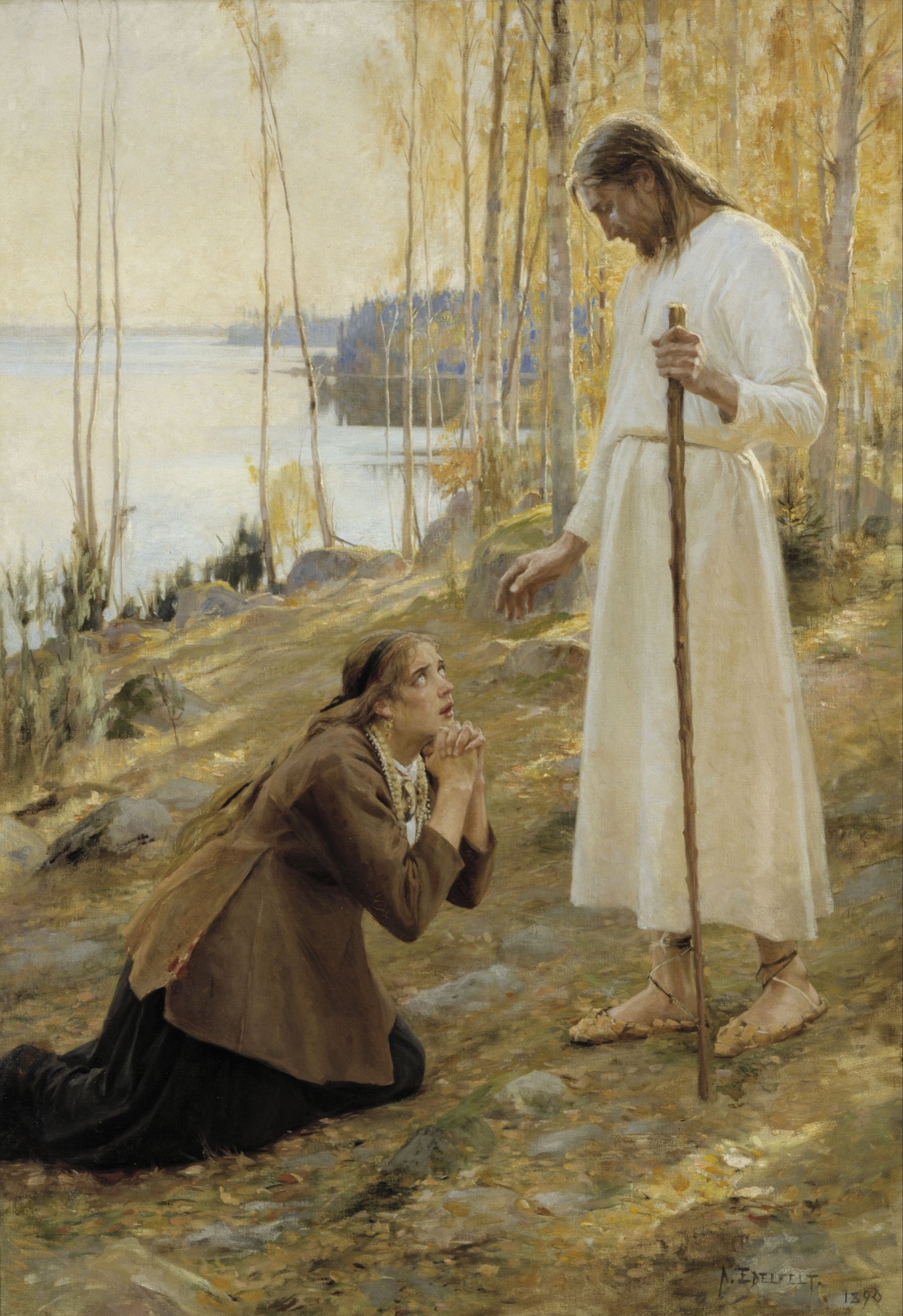
Edelfelt places the risen Christ and Mary Magdalene beside a Finnish birch wood. The Finnish title, Kristus ja Mataleena, joins the biblical figure to Finnish folk tradition, while the familiar landscape brings the Easter encounter close to Finnish viewers.
Biblical connection
John 20:11–18: Mary meets the risen Jesus near the tomb and recognizes him when he calls her by name.
Look together
What do the figures’ hands tell us? Which parts of the landscape look distinctly Finnish?
For reflection
What changes when a sacred story is placed in a landscape familiar to the viewer?
Enckell’s monumental altarpiece fills the east end of Tampere Cathedral. It does not concentrate on one dramatic instant. The long procession creates a sense of awakening, movement, and shared hope.
Biblical connection
Christian hope in the resurrection is expressed especially in 1 Corinthians 15 and in the Gospel accounts of Easter.
Look together
Where are the figures moving? Who appears to be waking, waiting, or helping someone else?
For reflection
Why might the artist have imagined resurrection as a shared procession?
The title deliberately brings together the Christian Madonna and the Kalevala’s Marjatta. The artist’s wife Mary and their child Marjatta were the models. This is not a biblical Nativity scene. It places Christian imagery, Finnish family life, and the national epic into conversation.
Biblical connection
Madonna imagery recalls Mary, the mother of Jesus, but this work’s meaning is not confined to one biblical passage.
Look together
Which details make the scene feel ordinary? Which details make it resemble a religious image?
For reflection
How can sacred meaning and everyday family life inhabit the same image?
Simberg did not prescribe one explanation for the painting. Its wounded figure and solemn bearers can invite thought about vulnerability, care, grief, and hope. It should not be treated as a literal illustration of biblical angels.
Biblical connection
The work can open a conversation about biblical calls to bear one another’s burdens and care for the wounded, but it does not depict a particular passage.
Look together
Where is each figure looking? What mood is created by the colors and the quiet landscape?
For reflection
Can an image offer comfort even when it does not tell us what happened or what will happen next?
The next chapter
A collection that can grow
The collection now reaches from medieval church art to the early twentieth century. It can continue to grow with additional altarpieces, stained glass, and other works whose histories and image rights can be verified.