Language, border, and identity
Meänkieli, “our language”
Meänkieli is a national minority language of Sweden with its strongest historical base in the Torne Valley and northern Sweden. It is closely related to Finnish, yet it has its own history, speaker communities, written forms, and legal status.
- Language family
- Uralic · Finnic
- Closest relatives
- Finnish and Kven
- Status in Sweden
- National minority language since 2000
- Speakers
- Estimates vary; roughly 50,000–75,000 is often cited
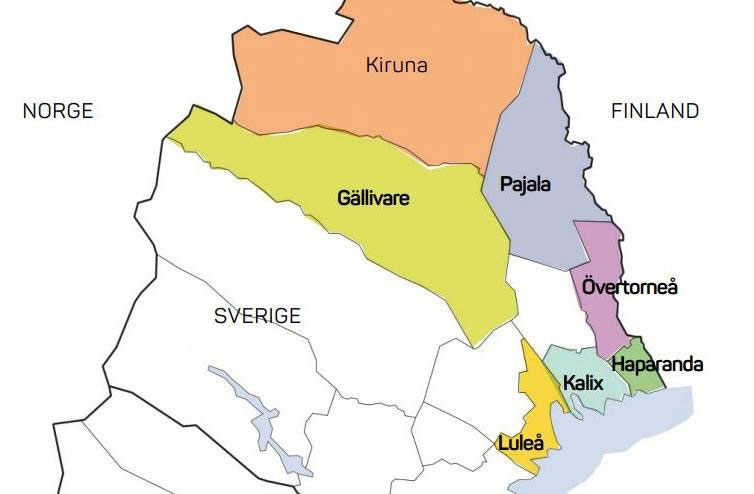
Where is it spoken?
From the Torne Valley across Sweden
Meänkieli has its strongest base around Haparanda, Övertorneå, Pajala, Kiruna, and Gällivare, though speakers now live throughout Sweden. The map shows administrative areas where language rights are especially strong. It does not show every speaker or a precise linguistic boundary.
A relative, not a copy
How is Meänkieli related to Finnish?
Meänkieli and Finnish belong to the same Finnic branch of the Uralic language family. They are substantially mutually intelligible, especially between Meänkieli and dialects of northern Finland.
The border drawn through the Torne Valley in 1809 divided a previously connected speech community between Sweden and Finland, then a grand duchy of the Russian Empire. West of the border, the language developed under strong Swedish influence while standard Finnish was being shaped differently to the east.
The boundary between “language” and “dialect” is not only structural. Meänkieli’s status also reflects its speakers’ identity and history, and Sweden’s decision to recognize it as a national minority language in its own right.
One family, different paths
These examples reveal close kinship without making the languages identical. Meänkieli has several varieties, so not every speaker uses precisely the same form.
| Meänkieli | Standard Finnish | Swedish | What to notice |
|---|---|---|---|
| meän | meidän | vår / vårt / våra | The name Meänkieli literally means “our language.” |
| met | me | vi | A distinct but readily recognizable personal pronoun. |
| oon | on | är | Long vowels appear in many Meänkieli forms. |
| taihvaissa | taivaissa | i himlen | An inserted h is characteristic of many Meänkieli words. |
| ko | kuin / kuten | som | The short form appears in the Lord’s Prayer, among other contexts. |
| pyörtyä | pyörtyä | gå vilse / svimma | A false friend: it can mean “get lost” in Meänkieli but “faint” in standard Finnish. |
From home language to public life
- 1809
A new border between Sweden and Finland divided the Torne Valley language area.
- Late 1800s–1960s
Swedification and Swedish-only schooling disrupted transmission to children. For many, Meänkieli remained an oral home language without opportunities to learn reading or writing.
- 1970s–1980s
Language and Tornedalian organizing gained strength. The name Meänkieli, meaning “our language,” gradually became established.
- 2000
Sweden recognized Meänkieli as a national minority language.
- Today
The language is taught, studied, written, and broadcast. Revitalization continues, although shortages of teachers and materials still limit access in practice.
Faith and language
The Lord’s Prayer in Meänkieli
The Church of Sweden publishes a Meänkieli church handbook. Its opening shows both the language’s kinship with Finnish and its distinct forms:
MeänkieliIsä meitän, joka olet taihvaissa. Pyhitetty olkhoon sinun nimesti. Tulkhoon sinun valtakuntasti.
FinnishIsä meidän, joka olet taivaissa. Pyhitetty olkoon sinun nimesi. Tulkoon sinun valtakuntasi.
SwedishVår Fader, du som är i himlen. Låt ditt namn bli helgat. Låt ditt rike komma.
Is Meänkieli an official language?
The precise term is one of Sweden’s five national minority languages; Swedish is the country’s principal language. Minority-language status requires public bodies to protect and promote Meänkieli, and speakers have stronger rights to use it with authorities, preschool, and elder care in designated administrative areas.
A related language in northern Norway