Finnish-American history in context
Finnish migration and community life in the United States
A selective history of how people from Finland reached the United States, found work, formed congregations and organizations, and maintained ties across generations.
Migration lens
How opportunity, law and community shaped migration
Large-scale Finnish migration to the United States took place chiefly between 1870 and 1920. Work, family networks and difficult conditions in Finland shaped the movement. Churches, halls, cooperatives and newspapers helped newcomers build community, while federal restrictions brought the era of mass migration to a close.
Explore the migration atlasAbout 340,000 Finns immigrated to the United States between 1870 and 1920.
The quota laws of 1921 and 1924 sharply reduced immigration; the 1965 law later replaced the national-origin quota system.
Before 1860
Early Finnish presence in North America
Finnish-speaking people reached North America in several different settings long before the era of mass migration.
Before European settlement
Indigenous homelands
The places where Finnish newcomers later settled were, and remain, the homelands of distinct Indigenous nations. Finnish-American history belongs within that longer history of place.
1638–1664
New Sweden and the Forest Finns
The New Sweden Company established a colony on Lenape homelands along the Delaware River in 1638. Some colonists came directly from Finland; others were Forest Finns, Finnish-speaking descendants of migrants, many from Savonia, who had settled in the forest regions of Sweden. The Dutch took control in 1655 and the English in 1664, but Swedish and Finnish families and Lutheran congregations remained.
Connection to our storyThe Library of Congress estimates that Finns may have formed roughly half of New Sweden’s approximately one thousand colonists. This early presence was part of European colonial settlement on Indigenous land and differed from the later mass migration to the United States.
1794–1867
Finnish connections to Russian Alaska
A Finnish carpenter, Aleksanteri Kuparinen, may have reached Kodiak as early as 1794. After Finland became an autonomous grand duchy within the Russian Empire in 1809, Finnish sailors, craftsmen, clergy and officials also traveled to Alaska. Some settled there, while others served for limited periods through the Russian-American Company.
1830s–1850s
A small stream of sailors and settlers
Finnish sailors, gold seekers and small groups settled in the United States before mass migration began. Mining and industrial recruitment would later increase the movement.
1860–1920
Work, family networks and mass migration
Industrial recruitment, difficult conditions in Finland and reports from earlier migrants helped turn a small movement into a major migration.
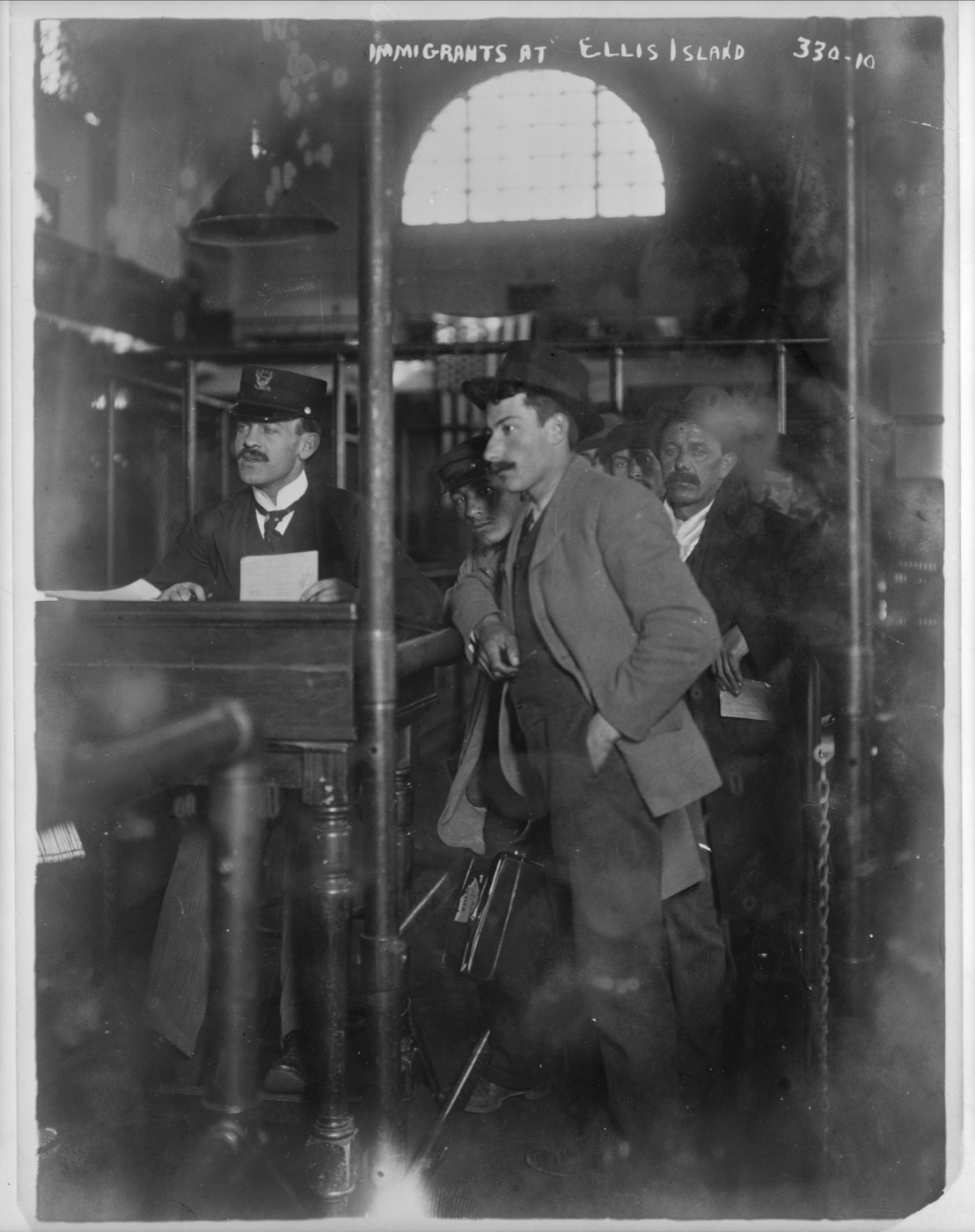
Migration in a photograph
Arrival meant inspection
Why this image matters
In this photograph from Ellis Island, immigrants wait to be processed at an official’s desk. The people’s nationalities are not identified, and not every Finnish arrival passed through Ellis Island. The image nevertheless makes visible the federal inspection many newcomers encountered.
Photograph: Bain News Service, about 1907–1917. Library of Congress. No known restrictions on publication. Resized. Open the source record
1860s–1870s
Recruitment and chain migration
Mining companies recruited Finnish workers living in northern Norway, and successful migrants encouraged relatives and neighbors to follow. Passenger records and parish documents show migration growing from western Finland and other regions.
1870–1920
The great Finnish migration
About 340,000 Finns came to the United States. Mining, logging, factories, farming, railroads and family networks drew people to the Midwest, Northeast and Pacific Northwest.
Connection to our storyFinnish churches, temperance halls, cooperatives, newspapers and labor organizations grew during this era.
Late 1800s–early 1900s
Ports and rail routes
Finnish travelers entered through New York, Boston, Canadian ports and other routes. Chicago’s rail network made it an important transfer point toward the Upper Midwest and, later, the Pacific Northwest, although many Finns never passed through Chicago.
1890 onward
Faith and community institutions
Finnish-American Lutheran life was not institutionally uniform. The Suomi Synod was founded in 1890 with close ties to Finland’s Lutheran church, while Apostolic Lutheran and other Finnish congregations developed in separate networks. Churches and related schools offered worship, education and mutual support.
By the 1920s
Communities across the country
Large Finnish populations had formed in Michigan and Minnesota, with additional communities in New York, Massachusetts, California, Washington, Oregon and elsewhere.
1917–1945
Restriction and continuing ties with Finland
New federal laws reduced immigration, but Finnish-American congregations and organizations continued to develop and to maintain relationships with Finland.
1917
A literacy test for immigrants
A new federal immigration law required many adult immigrants to pass a literacy test. Finnish immigrants generally had high literacy rates, but the law marked a broader movement toward federal restriction.
1921
The Emergency Quota Act
Congress imposed annual national quotas based on the 1910 Census. It was the first general numerical limit on immigration by nationality.
1924
The Immigration Act of 1924
The Johnson-Reed Act tightened national-origin quotas, favored northern and western Europe, required visas and excluded immigration by people considered ineligible for citizenship.
Connection to our storyTogether with economic and political changes, the quota system helped bring the era of mass Finnish immigration to a close.
1939–1945
Wartime aid and transatlantic ties
Finnish Americans organized civilian relief during the Winter War, including through the Finnish Relief Fund led by former U.S. President Herbert Hoover. Finland’s changing wartime position also created a complex public and personal situation for communities whose families and organizations remained connected across borders.
1945–1990
Postwar arrivals and generational change
Postwar migrants entered a different United States and joined Finnish-American communities already several generations old.
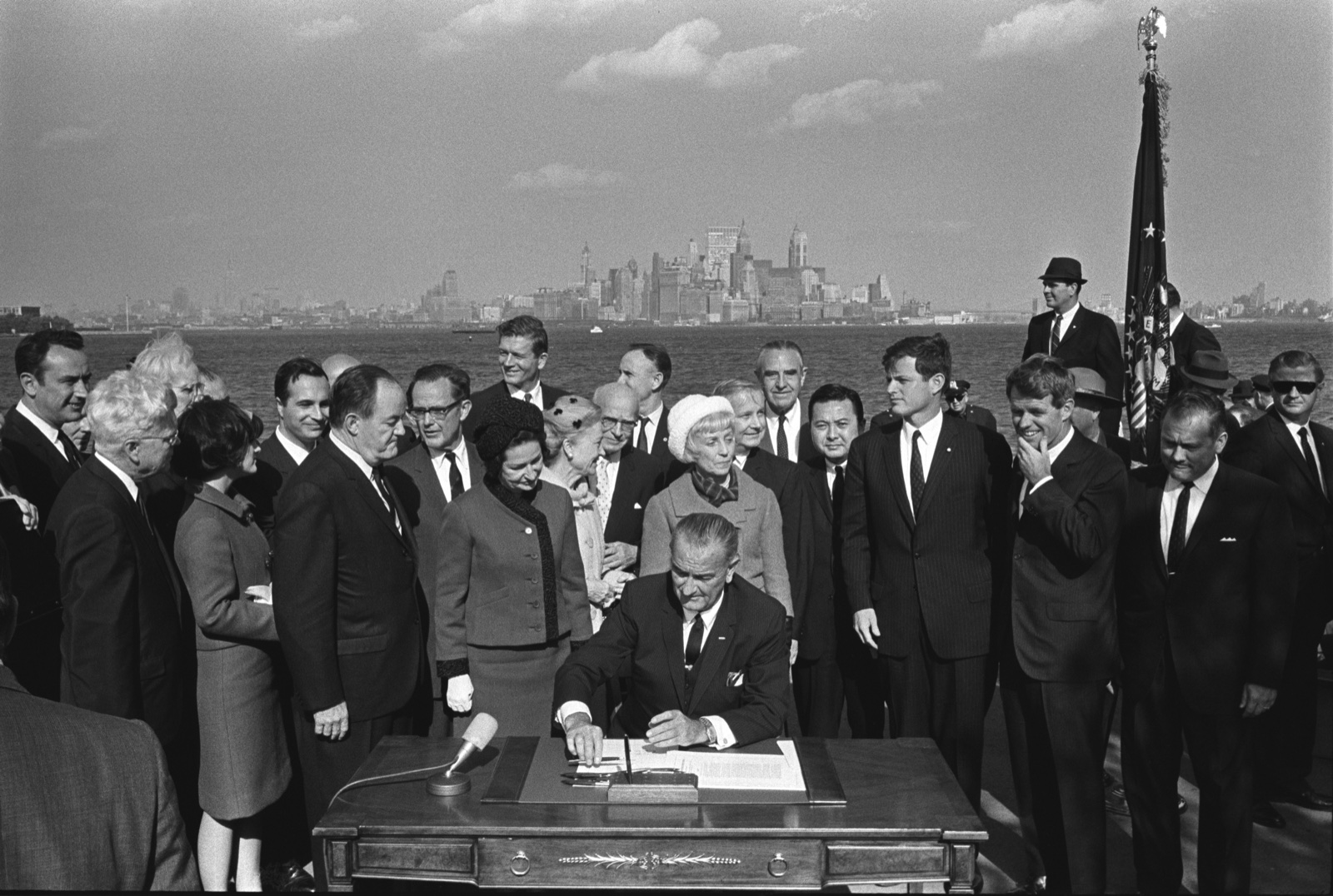
The law changes
A new framework in 1965
Why this image matters
President Lyndon B. Johnson signed the Immigration and Nationality Act on Liberty Island on October 3, 1965. The law ended the old national-origin quota system and emphasized family relationships and needed skills. Numerical limits and other immigration restrictions nevertheless remained.
Photograph: Yoichi Okamoto, LBJ Library, October 3, 1965. U.S. government work, public domain. Resized. Open the source record
1945–1952
Postwar immigration law
The War Brides Act of 1945 and Displaced Persons Act of 1948 created paths for particular groups. The 1952 Immigration and Nationality Act reorganized federal law and removed racial barriers to naturalization, but retained the national-origin quota system.
1962–1963
The Suomi Synod enters a larger Lutheran church
In 1962 the Suomi Synod approved the merger that formed the Lutheran Church in America, which began its work in 1963. The transition reflected both continuing Finnish traditions and the growing use of English in Finnish-American congregations.
1965
The national-origin quotas end
The Immigration and Nationality Act replaced the old quota system with preferences centered on family relationships and needed skills. Numerical limits and other restrictions remained. Immigration from Finland continued on a much smaller scale than in 1870–1920.
1970s–1980s
New arrivals join established communities
Students, professionals and families arriving from Finland encountered Finnish-American institutions created by earlier generations. Some remained permanently, while others returned to Finland; available census figures cannot fully measure that return migration.
Connection to our storyThe migration atlas presents the Washington figures that can be documented and clearly states what those numbers cannot tell us.
1991–today
A living Finnish-American community
Today’s community includes descendants of earlier migrants, newer arrivals, Finnish-speaking and English-speaking families, and people connected through faith, music, language and friendship.
1990s–today
Language and culture across generations
Congregations, choirs, schools, festivals, museums and cultural organizations continue to create places where Finnish language and traditions can be practiced, interpreted and shared.
Today
Migration is only one part of the story
People connect with Finland and Finnish-American life through ancestry, family, work, study, worship, music and community participation. No single migration narrative represents everyone.
Today
The Pacific Northwest connection
Finnish Lutheran Church of Seattle is one part of a wider regional landscape of Finnish and Nordic congregations, schools, cultural organizations and gatherings across Washington, Oregon and British Columbia.
Connection to our storyContinue with the migration atlas for documented census figures and regional community locations.
Go deeper
Sources and further reading
This page is a selective introduction to Finnish-American history. The linked institutional sources provide fuller chronology and documentation.