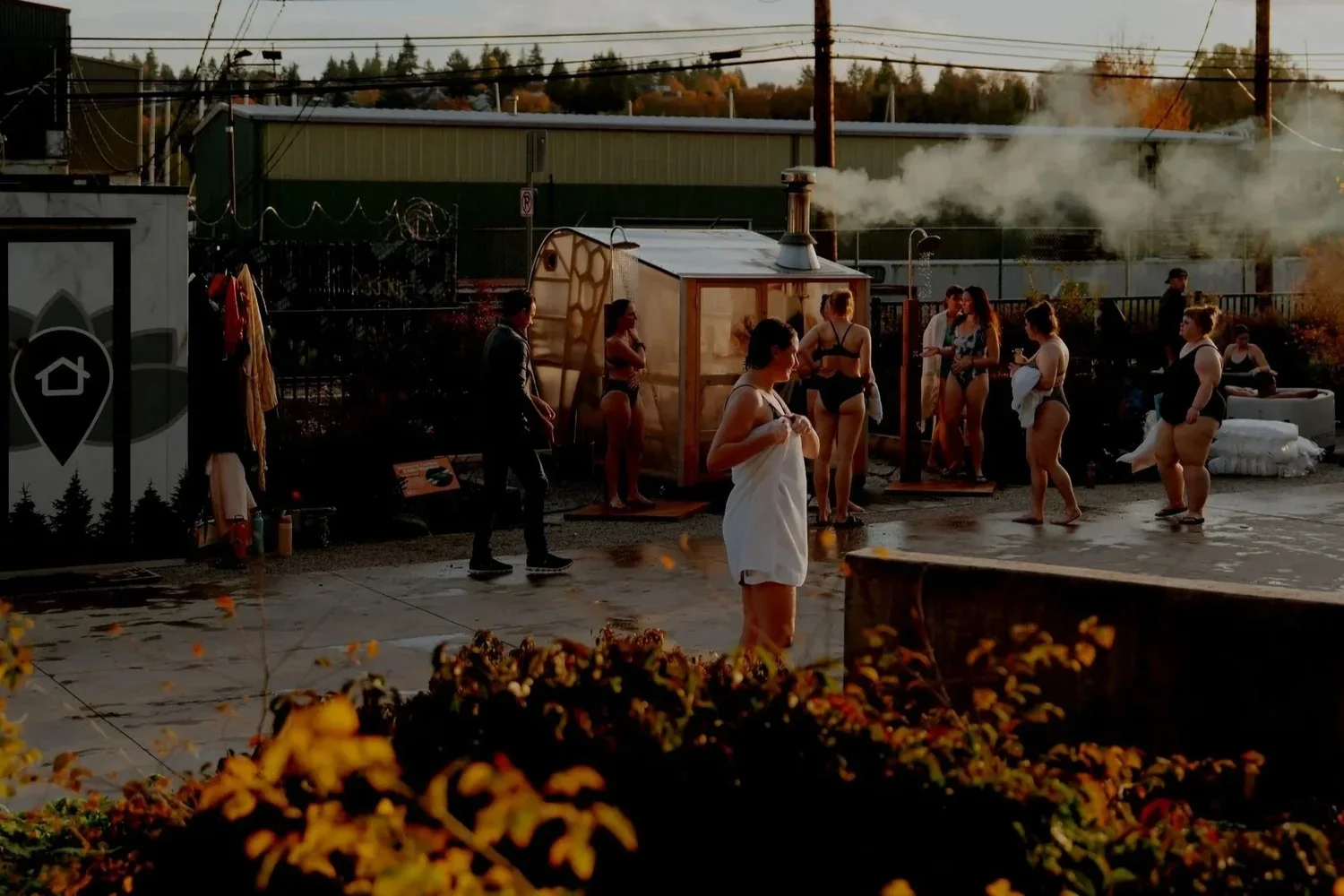
On November 8, the Finnish Choral Society of Seattle made its first appearance at the Seattle Sauna Festival. The choir performed Finnish sauna songs on the National Nordic Museum’s Sun Terrace, then carried the music through the festival grounds with roaming sauna caroling.
The choir’s friend Steve Solkela joined the singers on accordion. Its warm, rhythmic voice suited a program that moved easily among choral music, folk song, and communal fun.
Nine songs in the festival repertoire
This was more than a list of sauna songs. Five pieces lead directly into löyly, birch whisks, and the warmth of home sauna; three widen the scene to courtship, longing, and folk-song humor. The Swedish Hej, tomtegubbar adds a Nordic moment of conviviality.
Each profile keeps the original Finnish or Swedish title and distinctive words in view. A plain-English title opens the door; closer notes on the text, choral treatment, and place in the program reward readers who already know the language or the repertoire.
Saunalaulu
Sauna Song
Inside the text
The singer would live, eat, and luxuriate in the sauna day and night. Anger cools there, bitterness subsides, and Saturday sauna feels almost like heaven. The exaggeration makes an affectionate portrait of a sauna enthusiast.
What to listen for
Voice parts trade lines while the lower voices repeatedly interject löylyä, calling for more steam and heat. The choir does not merely describe sauna; it stages a compact comic scene.
Role in the set
A succinct declaration of the set’s premise: sauna is both a place and a state of mind.
Löylyä lisää!
More löyly!
Inside the text
This is a comic sauna manifesto. Its verses move through Saturday sauna, cleanliness, quiet, cooling off, and good conduct. They also insist that rank and status carry no weight inside.
What to listen for
A marching gait and the recurring demand for more löyly turn the rules into a communal anthem rather than a lecture.
Role in the set
It makes sauna custom into an exuberant call that singers and listeners can share.
Kukapa sen saunan lämmittääpi
Who, then, will heat the sauna?
Inside the text
The first verse asks who will heat the sauna and who will throw the löyly. The answer emerges through teasing exchange. The second verse turns directly toward courtship, with a girl inviting a boy into her “school.”
What to listen for
Repeated questions, lilting nonsense syllables, and answering phrases make this sociable dialogue, not a checklist of sauna chores.
Role in the set
Sauna becomes a meeting place where useful work, teasing, and courtship overlap.
Terve löyly, terve lämmin
Hail, löyly; hail, warmth
Inside the text
Löyly and warmth are greeted almost as active presences. The words ask them to make health, build peace, and bring healing; old Väinämöinen appears in the text as well.
What to listen for
Alliteration, parallel lines, and accumulated phrases give the song an incantatory pulse reminiscent of runo singing.
Role in the set
Among the comic songs, it introduces the sauna’s more solemn imagery of care, restoration, and healing.
Saunavihdat
Birch whisks for the sauna
Inside the text
Children gather birch branches and bind whisks for the home sauna. A mother’s touch is gentle and the home löyly warm. In the final thought, she hopes her children will be kept safe from the cold world.
What to listen for
A direct folk melody carries the domestic scene, while the closing image opens it into something larger: protection and maternal love.
Role in the set
It brings childhood, family, and home into the program, showing the sauna’s emotional meaning and not merely its objects.
Lauantai-ilta
Saturday Evening
Inside the text
The singer waits until ten, but the beloved never comes. Suspicion of another love grows, and the singer ends by saying they want to return the striped silk scarf the absent beloved gave them the previous Saturday.
What to listen for
Light tra-la syllables sit beside a disappointed narrative. The buoyant folk-song surface and the hurt beneath it pull in different directions.
Role in the set
This is not actually a sauna song. It widens the Saturday-evening setting into a folk-song world of waiting, memory, and love.
Minun kultani kaunis on
My beloved is beautiful
Inside the text
The beloved is beautiful, yet each description turns into affectionate irony: body, eyes, and other features resist an idealized portrait, and by the market scene even the horses laugh. Praise and comic contradiction belong together.
What to listen for
Kuula’s mixed-choir setting gives a concert frame to a variable folk song while retaining its buoyant hei juulia refrain and mischievous storytelling.
Role in the set
It joins love, humor, and Finnish-Karelian oral-song tradition. The closer look below follows its history further.
Kosioretki
The courtship journey
Inside the text
A young man harnesses his chestnut horse and sets off from high Kullan kukkula to court a bride. He hopes to bring his mother a daughter-in-law if he finds a true rosy-cheeked sweetheart.
What to listen for
Recurring ai ruunilla and kylillä phrases, together with staggered choral entrances, keep the journey in motion. The whole choir seems to travel with the suitor.
Role in the set
It continues the set’s playful courtship thread and supplies a brisk narrative song near the close.
Hej, tomtegubbar
Hello, little tomte fellows
Inside the text
The singers call on the tomtegubbar to raise their glasses and be merry. Human time here is short and life carries effort and trouble, which is reason enough to share the present moment.
What to listen for
A compact verse, repeated hej calls, and a firm pulse make it instantly social and participatory.
Role in the set
The Swedish-language finale added Nordic conviviality to the nine-song set and reflected the multilingual currents long present in Finnish musical life.
Why this collection is special
Together, the songs show how sauna, everyday work, courtship, and communal fun become musical heritage. They do not explain sauna and folk song from the outside; they let listeners enter their vocabulary, humor, memories, and companionship. In Seattle they gained another layer of meaning when a Finnish choir sang them during its first Sauna Festival appearance amid the Pacific Northwest’s growing sauna culture.